The Sargent Wing
Six invented portraits, hung for one owner. Turn a canvas; the writing is behind the paint.
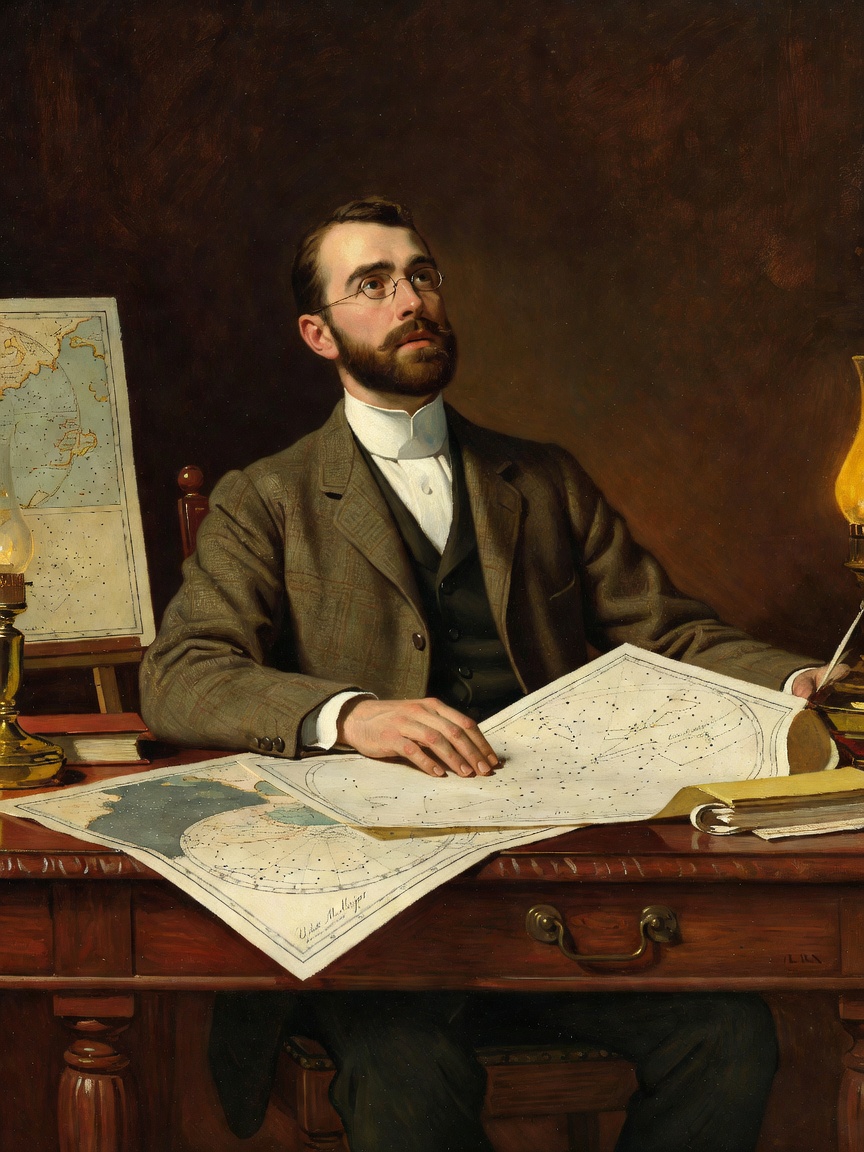
The Cartographer, Evening
How we think
The fleet is how more than one operation runs at once.
[01]
the unit
The unit is a standing workspace with memory, a repository, a task list, and the systems it is connected to. When work comes in, the fleet that takes it already knows the work.1
[02]
the standing fleet
A fleet is many of those units standing at once, kept separate by company and purpose. When work comes in, it goes to a workspace that already knows the operation. Agents get built and retired as the work changes; what persists is the memory.2
[03]
the overlap is the work
The work is in the overlap: one agent is rarely the whole job. A question moves through several worldviews and gets challenged. A build moves through research, planning, dependencies, and review. The shape is the same: context, task, execution, then a handoff a person can inspect. Work that runs through this shape is on the examples.3
[04]
a person decides
A person designs the contexts, assigns the work, redirects it, and decides what becomes part of the next state. The agents keep the work moving.4
Notes
- [1] The fleet figure above shows one work item collapsing: the fields behind it are standing agents, durable context, and running services.
- [2] The count (10+ fleets, 2–50 agents each) and the daily texture of the fleet live on How we run. Agents are built and retired as the work changes.
- [3] The workspaces behind those cases are in daily use. They aren't demos reset after a screenshot.
- [4] Operating sources: STRATEGY.md, OPERATIONS.md, notes/braydons-view-of-ai.md (internal).
turn the canvas back

The Conductor of Small Machines
How we run
the setup
Set Earth keeps a fleet running across its operations.
The goal is to never be the bottleneck, so the work runs on fleets of agents. An agent is a software assistant set up to do real work on its own: it reads files, runs commands, writes drafts and code, and checks its own work before showing a person. A fleet is a team of them assigned to one job under a person’s direction. A typical week has somewhere between 10+ fleets running 2-50 agents each. Some fleets are working on and for companies, some on research, some on a build, a review, a memo, or a problem still being thought through. Some are working; some are waiting.
To make all this functional, agents get a place to work, the memory they need, the repository or source system they are responsible for, and a task list. All that context is part of the agent. An agent or fleet might sit idle for a day; the context is still there when the work resumes.
Currently, Herdr with Pi as the harness is the go-to for fleet operations. Everything stays visible: the agents, the workspaces, what is blocked or moving. The agents have different roles and different model tiers; different models get picked depending on the work. There are also layered and sequenced skills that call different agents and different models depending on the work. The newest development is a “Collective” agent framework that lets a fleet operate on its own, relatively unsupervised. Wild times.
Behind the workspaces are the services that keep things working: memory and state backends, repository and task graphs, timed jobs, webhooks, harness hooks, health checks, and launch-and-reconcile processes. Some work starts when a person assigns it. Some starts when a timer, event, or service says it is time. With the new Collective, the fleet can also start work on its own; what it starts still comes to a person for review.
the why
The expensive and exhausting part of running operations like this is the judgment.
More work used to mean more hours, or more people, or both. This way, the expensive hours go to the framing, the thinking, and the decisions. The cheap hours run as standing work in the background. That gives a person much more scale than they used to have.
The fleet also changes what can be taken on at once. The old way was one thing at a time, with everything interrupted when something urgent arrived. Now several operations stay warm at once.
the handoff
The context survives the prompt.
A task can begin in a repository, pick up decisions from memory, use a service, and leave a result in a task graph or review queue, or just in a document.
A person sets the context, assigns or redirects the work, and inspects the results. To be fair, there is a lot of steering along the way.
what stays by hand
The decisions, the framing, and the boundaries stay with a person.
A person decides what work gets done, whether a result is good enough to use, and whether a system keeps running.
No autonomous inbox replies here. Tried it; not good. AI generates many drafts from materials, but a person always edits and sends.
The agents also produce too much stuff: drafts, artifacts, digressions. It is a lot to wade through. There is intuition in what to pay attention to.
The system also stays separated by company and purpose. Memory keeps context between sessions. It is not one giant pool. Operational state keeps current facts, sources, freshness, and proposed changes.
the cost
The system runs on maintenance.
It’s nowhere near perfect. Memory drifts, agents need their boundaries reset, and a service update breaks a connection. A task graph needs repair, a timed job fails. Nothing breaks silently, though: the agents report their own failures, so a person sees what broke and decides the fix. The system has to be watched, updated, and occasionally simplified.
the difference
How this is different from the old way.
Ten years ago, this was one company, a handful of direct reports, and a calendar. Work moved serially: a person in every meeting, on every thread, and often the bottleneck.
Now several operations stay warm at once: a client engagement, a build, research, a talk. Memory keeps the context between sessions, and a new standing workspace with the right role and review loop takes an afternoon to spin up. Braydon still makes the judgment calls, now at review checkpoints instead of at the front of every task.
the outcome
The system earns its keep.
Four companies and this consulting practice now run on AI, and a week that used to end with everything unfinished now ends with most things in a decent shape. The system itself is infrastructure: watched, simplified, and repaired. That trade is worth it.
turn the canvas back

The Agreement
Work with Set Earth
Hire Set Earth to run a piece of your operation, on a retainer.
Set Earth is Braydon McCormick, the software assistants that take the work that repeats, and specialists brought in as engagements need them. Braydon makes the operating calls.
Week one, you walk Braydon through the operation and the scope gets written down: what Set Earth runs and what it doesn’t touch. The reports, the monitoring, and the follow-ups move over. The decisions in front of you arrive in one ninety-minute session each week. If it isn’t working by day thirty, you stop.
If your team wants the workshop first, five working days building a real application, that’s a LightForge Works offering now, at lightforgeworks.com.
This is for companies between ten and two hundred fifty people, with an executive who owns operations and a team that does the work.
the remit
You describe the work in your own words, and the scope is agreed in writing in week one.
The remit is amended in writing each quarter by Braydon; anything outside it waits for the review.
In practice the standing work is monitoring, recurring reports, and the decisions that don’t need a person every time. It’s documented, and Braydon audits it weekly. How the setup runs is on How we run; what it can’t do stays with Braydon.
the cadence
The rhythm is agreed up front, and it stays put.
- A weekly judgment session.Ninety minutes on the operating decisions in front of you.
- A shared channel.Answers come the next business day.
- A monthly operating review.Ninety minutes on the operating numbers in the remit.
- A quarterly remit review.The review looks at what ran and what changed.
You’re not paying by the hour; the cadence is the agreement. If you need more rhythm than that, the remit changes.
the lengths
A month, a quarter, or nine months.
The first month is the heavy one: the remit gets written and the standing work moves over. By month nine your team is doing more of it and Set Earth is reviewing. The rate drops with the length because the work gets lighter.
| Length | Monthly | Total | What it's for |
|---|---|---|---|
| 1 month | $6,000 | $6,000 | The pilot month. |
| 3 months | $5,500 | $16,500 | The heavy quarter, when the practice gets built. |
| 9 months | $5,000 | $45,000 | Most of a year, with the taper. |
A month is how most engagements start. You get the remit, the standing work handled, and a real month of the operation running. Day thirty is the honest checkpoint, the same one from the top of the page.
the bounds
Five seats, a written scope, and terms that say what fractional means.
Set Earth runs five seats at a time. That’s the number that keeps real judgment behind every seat. Onboarding is one seat at a time, so only one client is ever in its first months. When the seats are full, you get a start date.
Specialists work inside the same remit. Anyone brought in works under the same written scope and NDA, and Braydon still makes the calls.
It’s a fractional seat. If the work outgrows it, you need a hire, and help writing the spec comes with the seat.
You can stop whenever you like. Leave a nine-month at month four and the months you ran get billed at the three-month rate. After the term it renews monthly, thirty days’ notice either way.
How an engagement runs
The first three months are the dense ones: Braydon writes the remit, the work moves over, and the practice stands up. Then it tapers. Your team runs more of it, and the practice stays close on review. One program at a time inside the remit, scoped to something that ships.
Terms
Set Earth Inc, invoiced monthly in advance, mutual NDA. You own everything built on your stack; Set Earth keeps its methods and tooling. For early-stage work, equity can stand in for part of the fee. First step is a fit call; reply to b@mcco.us if you would rather write first.
turn the canvas back

The Enquirer
Frequently asked questions
What do you actually do?
Set Earth works with executives to build how they operate with AI: your own practice first, then your team’s. A controller who knows freight invoices and month-end close can hand AI the journal entries. A person who doesn’t know the operation can’t tell whether what AI built is right. The work is hands-on, on your stack, with the first pieces running inside the first month.
Anyone can build an app in an hour now. Why do I need you?
Anyone can build an interface in an hour. The hard part is whether it attaches to your data the right way, whether it understands the schema, and whether the result is right. You can’t see that, and you wouldn’t know to ask it to explain. The weakest link is the person who can’t evaluate the output. Operating judgment is what catches what the fast build misses.
What does it cost?
The retainer is $6,000 for a month, $5,500 a month for a quarter ($16,500), or $5,000 a month for nine months ($45,000). The length you commit to sets the rate; most engagements start with the month. The workshop now runs under LightForge Works, the software firm Braydon is part of; its pricing lives at lightforgeworks.com. For early-stage work, equity can stand in for part of the fee. After any term, renewal is monthly; thirty days’ notice either way.
Why not hours?
Metering every message turns a relationship into a support desk. You’re buying attention on your operation at an agreed rhythm. If you consistently need more than the rhythm, the scope changes instead.
What happens in the first month?
Week one is inside your work: your week, the people one level down, your tools and data, and whatever’s already running that nobody sanctioned. By the end of the week the scope is written. In weeks two to four the standing work moves over and runs: the first pieces go live on your stack, the first judgment sessions start, and what comes next gets written up. If it’s not working by the end of the month, you stop. Details: the retainer.
Is this a course? Will you train my team?
No. Training teaches tools, and the tools change monthly. The retainer builds the practice with you: workflows, governance, habits. Your team learns it by running it. The team workshop is a LightForge Works offering now, at lightforgeworks.com.
What if my team resists?
Usually they don’t. They’re already using it and would rather it be sanctioned. The resistance is more often the executive’s: the fear of not understanding it, or of the team being ahead. The work starts with you, so that by the time it gets to the team you’re the one who knows how it works.
Who on my team should be involved?
The people already using it. Most companies have one or two quiet power users: the person whose spreadsheet everyone else depends on, and the one already pasting work into a chat window to save an hour. They become the core of a small cross-functional group, with one person from operations, one from IT or compliance, and one from the business side. The group runs it after the engagement; the tinkerers make it stick.
We’re regulated or audited. What touches our data?
Only what your policy has cleared. Day one starts with fifteen minutes with whoever owns IT or compliance, so the rules are known before anything is touched; the work stays inside them. The regulated work behind this practice has run under FDA and pharma compliance; if your constraint is an ISO registrar or a customer audit, that same conversation is where it gets mapped. The detail is on the data-handling page.
Do you build software?
The retainer builds the practice: workflows, tooling on your existing stack, small automations, the operating model. When the work turns up a real application that needs building, LightForge Works (a firm Braydon is part of) can build it, rather than stretching a retainer into a software project.
How many clients do you take?
Set Earth runs five seats at a time and onboards one at a time, so only one is ever in the dense first months. When the seats are full, you get a start date rather than a worse first month.
Can we start smaller?
Yes. Take one month at $6,000 and decide at the end of it. If your team wants the workshop first, that lives at LightForge Works now.
What’s your background?
Braydon has run companies across pharma, devices, and software; raised capital; reported to boards; taken a company through a regulatory pathway; shut one down. He writes software and runs his ventures on a system of agents he designed for them. Before all that, a PhD in composition. The short version is on the about page.
Can I talk to a reference?
Where clients allow it, yes. Much of the work is under NDA in pharma and devices, which is why the examples are anonymized. On a call, those cases get walked through from the inside, and a reference gets connected where the client has cleared it.
How do I start?
Book a fit call at the booking page, or reply to b@mcco.us if you’d rather write. The reply lays out what the first month looks like for a shop like yours.
turn the canvas back

Figure in Black, Standing
About
Set Earth is Braydon McCormick, the software assistants that take the work that repeats, and specialists brought in as engagements need them.
I’ve run companies across pharma, devices, and software for twenty years: built them, grew them, sold one, shut one down, reported to boards, took a company through a regulatory pathway. I’m involved in six today. The fleet that runs this practice’s own work built and deployed this site. The operating work I do now is the same job I’ve always done; the fleet is what lets me run more than one at once. When the work surfaces a real application that needs building, LightForge Works, a firm I am part of, builds it.

The companies
The six:
- Set Earth Consulting: fractional COO work on a retainer, for companies adopting AI.
- LightForge Works: the software firm I’m part of; it builds applications, and the AI Operating Sprint now runs there.
- Synthyra: a biotech AI company building protein language models. I’m its fractional CEO and head of business development.
- Navicyte: a life-sciences company working a product through the FDA pathway.
- Plum Spun: an operating company of mine, d/b/a Aclara. Aclara makes anti-microbial materials; I’m a co-inventor on its fabric patent, US 11,975,221.
- Concresca: a new company, still in stealth.
How I think
When a problem is tangled, I start by asking what decision is actually being made. Then I name what good looks like, state the constraints, and map the workflow far enough to see the handoffs and the failure modes. Then I pick the smallest validating path.
When work fails, it’s usually one of three things: the decision is vague, the owner is unclear, or the proposed system has never run real work. I ask what it costs when the thing breaks, what the return is if it works, and where a person still has to verify the result.
This is also how I build with AI. I care less about adding another tool than about what the system can see, what it’s allowed to do, where it hands work back to a person, and whether it helped.
Where the value comes from is my working theory: interactive AI, the kind you work with directly rather than systems built into a product, pays out at the intersection of three things. Operator craft: how these systems work and how to run them. Domain expertise you can say out loud: AI amplifies what you can explain, not what you know in your hands. And the accurate language of your field: precise words are what let it do expert work. Raise any one and the results get better; the ceiling is where the three meet.
Music
I trained as a composer. PhD in music theory and composition from Boston University; BA in Russian and Music from Colby College. Composition taught me to hear a system as more than a collection of parts. A piece works because the voices have roles, enter at the right time, and yield when another voice needs the space. The same is true of a well-designed operating system. Each part needs to know what it’s there to do and how it relates to the others.
The Boston University Orchestra performed my Symphony No. 1. The third movement:
More is on SoundCloud.
Coordinated agents get interesting when the roles, timing, boundaries, and handoffs make a person’s work more coherent.
Endurance
Running and triathlon raise the same questions I bring to systems. You pace the distance, and you carry the load you actually have. A system that looks impressive at the start is worth less than one that keeps working, and the people who live with it have to be able to maintain, inspect, and improve it.

Education
Elsewhere: LinkedIn · SoundCloud.
turn the canvas back

The Widow, Candlelit
This canvas does not turn. The sitter asked to be left alone with her candle.
she keeps the room dark